Documentation
Scoring
Moving Day pulls live scores for every golfer in the field and recalculates your team's total every few minutes while a tournament is live. Two settings control how that total is built: the scoring method, and the missed-round penalty for golfers who don't finish - separate settings for a missed cut versus a withdrawal or disqualification. Both are part of a competition's rule preset (Classic, Hardcore, Forgiving, Casual, or Custom), set in step 3 of the create-competition wizard.
Scoring methods
All golfers count
Every golfer on the roster contributes to the team total, every round. Simplest to follow, and it makes every pick matter, since there's no dropping a bad score. Classic, Hardcore, and Casual all use this.
Best N of M
Only your roster's lowest-scoring N golfers count each round; the rest are dropped for that round, not removed from the roster. Best 4 of 5 and Best 5 of 6 are the two ready-made shorthands (the Forgiving preset uses Best 5 of 6); Custom lets you pick any N for any team size, e.g. best 3 of a 7-golfer team.
Worked example: a Best 4 of 5 team posts -2, -1, 0, +1, +5 for a round. The +5 is the worst score, so it's dropped and only the other four count: -2 + -1 + 0 + 1 = -2 for the round. Ties at the cutoff still only keep N scores - which of the tied scores gets dropped isn't meaningful, since they're equal anyway.
When a golfer misses the cut, withdraws, or is disqualified
A golfer who doesn't finish the tournament still needs a score for the rounds they missed, so their team isn't simply missing data. The penalty option controls how that's filled in, set separately for missed cut versus withdrawal and disqualification (WD and DQ share one penalty type, but are configured as two separate settings, since a pool might want the same harshness for both, or not) - most pools treat a DQ or WD more harshly than a routine missed cut.
Swap before his first shot. A golfer who withdraws before he hits a shot can be replaced by his team, free and without approval, right up to his own round-1 tee time - even if other groups are already on the course. The replacement has to be a golfer who hasn't teed off yet (same tier in a tiered pool, undrafted in a draft), and scores from his own first shot. Once the tee time passes, or he's played a hole, the window closes and the WD penalty applies. The commissioner is told about every swap.
A missed cut only costs you after the cut round
A cut golfer's real scores still count for every round up to and including the round the cut happens (round 2, for a standard 4-round event) - the penalty only kicks in for the rounds after that, which the golfer didn't play. Missing the cut doesn't retroactively erase a good Thursday and Friday.
Worked example (cut after round 2, missed-cut penalty +10): a golfer posts real rounds of -1 and -1 for rounds 1 and 2, then misses the cut. Rounds 1 and 2 still score -1 each; rounds 3 and 4 (which the golfer never played) each get the flat +10 penalty instead of being left blank.
A withdrawal or DQ costs you from the moment it happens
There's no equivalent grace period for a withdrawal or disqualification - any round without a real score gets the configured WD/DQ penalty, starting with the round it happened in. There's also no "no penalty" option for WD/DQ the way there is for a missed cut: a walk-off always costs your team something, even if it's just the lighter "even par" setting.
The penalty options
The missed-cut and WD/DQ dropdowns don't offer the same choices - WD/DQ penalties run harsher and always apply something:
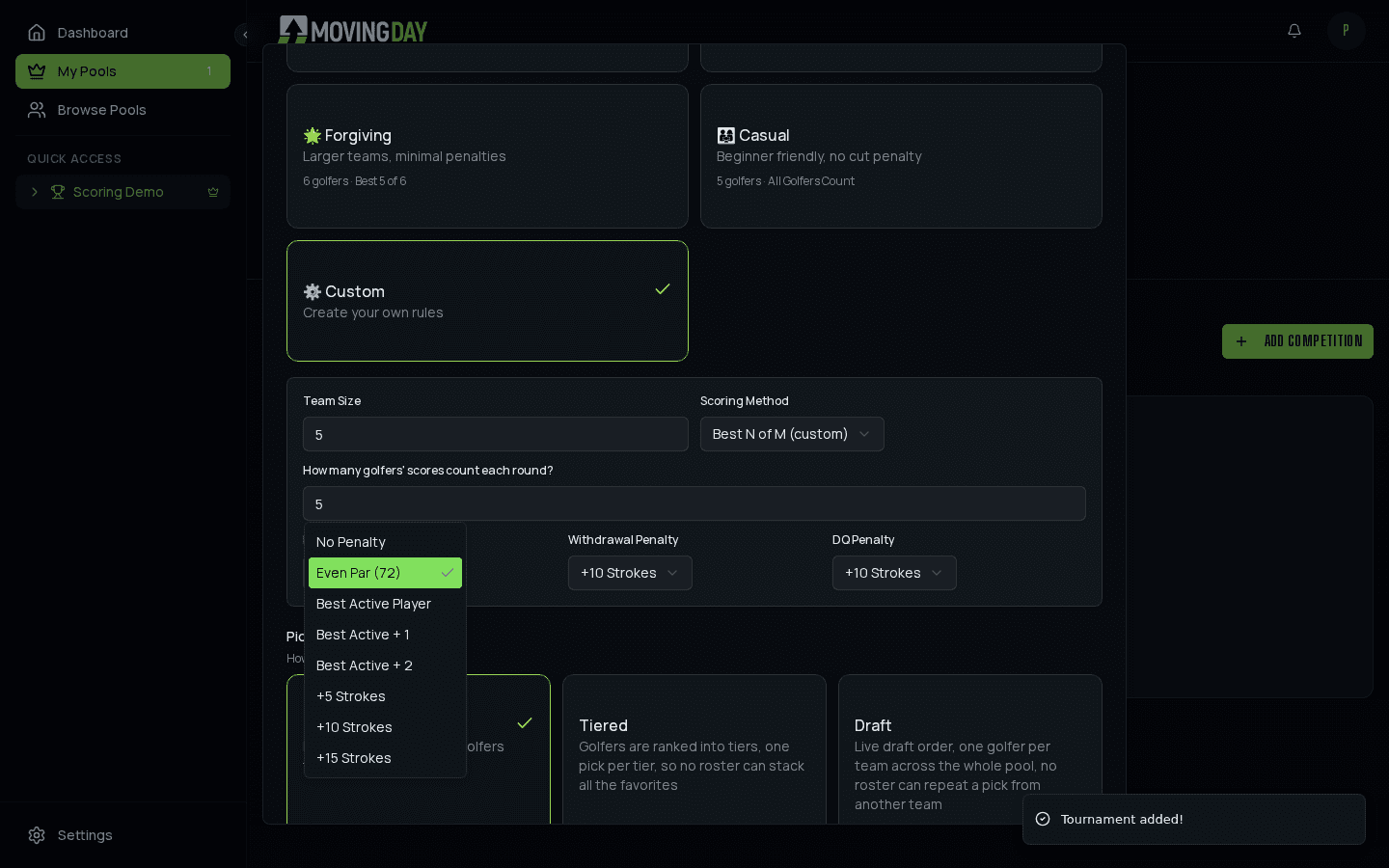
- Missed cut: No Penalty (round simply excluded, used by the Casual preset), Even Par, Best Active Player, Best Active +1, Best Active +2, Field Median +2 (the whole field's median score for that round plus two - used by Moving Day pools), +5 / +10 / +15 Strokes.
- Withdrawal / DQ: Even Par, Field Median +4, Best Active +5, Best Active +10, +10 / +15 / +20 Strokes. No "none" option, and no plain (un-offset) Best Active.
Fixed strokes over par
A flat penalty is applied for every round the golfer didn't play - simple and predictable, and independent of how the rest of the field scored. The Classic preset uses +10 for a missed cut; Hardcore uses +15/+20.
Even par
The missed round is scored as even par (0 to par): a lighter, no-frills penalty.
Best active teammate (+N)
The missed round is filled in relative to the best (lowest) real score any of your other rostered golfers posted that same round, plus an offset (e.g. best active + 5). This scales the penalty to how the field actually played that week, rather than a flat number that might be too harsh in bad-weather rounds or too lenient in easy ones. If none of your other golfers have a real score for that round either, it falls back to par (0) as the base before adding the offset.
Ties
Two teams with the same total never share a place in the overall standings. Equal totals are broken by count-back on your own golfers: each team's golfers are lined up best-first (penalty rounds included) and compared one at a time - the team whose best golfer scored lower wins; if those match, the second-best golfers are compared, and so on. Two teams with identical lineups can't be separated that way, so the earlier entry wins. A team that holds its place on a tiebreak shows a small "TB" next to its rank. Season standings with equal point totals are separated by earliest entry as well. Round tabs (Round 1 leader, Moving Day leader, and so on) keep golf-style shared places, since they're side categories rather than the pool result.
Side games
A competition can switch on two optional side games that sit next to the standings and never affect who wins the pool. Both are played round by round within a tournament, and nothing ever carries across tournaments. Skins: every round is worth one skin, taken by the lowest team score for that round; a tie for low rolls the pot to the next round, so a round after two ties is worth three skins. Skins still carried after the final round go unclaimed rather than rolling into the next tournament. Rabbit: the hole game your foursome plays, for teams. The rabbit is loose on the first tee; win a hole outright (same counted golfers as skins) and your team catches it. If another team then wins a hole outright the rabbit is set loose again - it never passes hand to hand. Hold it after the 9th and you win the front nine; it's loose again on 10, and holding it after 18 wins the back. Ties change nothing, and each round is its own chase. In a season each tournament is its own skins game and its own rabbit, and the leaderboard keeps a running tally of skins and nines won. A hole in either game is final once everyone in the game has played it; a round in progress shows the provisional low and who has the rabbit right now. Both games need hole-by-hole scoring, which is available for PGA Tour events. Skins and rabbit winners appear in the pool's History tab and on player profiles. Side games are a Pro commissioner feature. They are normally an optional buy-in: members pay the commissioner outside Moving Day for each tournament they want in on, the commissioner ticks who's in on the competition's Side Game Buy-ins page, and only those teams count in that tournament's skins or rabbit (the leaderboard shows the pot). A commissioner can instead set a competition so everyone is in automatically.
Before round-by-round data exists
Early in a tournament (or for older data that only ever recorded a cumulative total), Moving Day may not yet have a round-by-round breakdown for a golfer. When that happens, the same scoring method and penalty rules are applied to each golfer's cumulative total instead, and the result is stashed in the team's Round 1 score simply as a place to put it - it's not claiming the whole result happened in round 1, just that there's no per-round split to distribute it across yet. Once real round-by-round scores come in, this is recalculated properly per round.